He who was seated on the throne said, “I am making everything new!” Then he said, “Write this down, for these words are trustworthy and true.” (Revelation 21:5)
New. Who thought that such a small and apparently simple word could contain so much potential for debate?
I asked myself this question after I read this from an online Christian article:
…a Christian must remember that God is in control and that this world is not our home. God will one day erase this current universe (2 Peter 3:7-12) and replace it with the New Heavens and New Earth (Revelation 21–22). How much effort should be made “saving” a planet that God is eventually going to obliterate and replace with a planet so amazing and wonderful that the current earth pales in comparison? (https://www.gotquestions.org/climate-change.html)
But this attitude towards creation saddens me. In my opinion, it’s a shallow way of looking at God’s relationship with his creation, and I’d like to suggest a better way to look at the issue.
To begin, we need to understand that the word “new” has more than one meaning. It can mean “new and different”; but it can also mean “new and restored”. The New Testament, in fact, uses two words: kainos and neos. The former means new in nature or quality; the latter means new in time or origin. The word used in Revelation 21, in both v.1 and v.5, is kainos. Thus it does not refer to the emergence of a cosmos totally other than the present one, but rather a cosmos which, though it has been gloriously renewed, stands in continuity with the present one.
Suppose I buy a car, operate it for 10 years, then decide to sell it and buy a new car. In this setting, new means different. The old car is gone; the new car is another car that has no connection to what went before.
On the other hand, suppose I am obsessed with old cars. One day I find an old vintage car in a junkyard. I fall in love with it, take it back to my workshop, and spend the next two years stripping and cleaning the engine, panel beating and painting the body, repairing the electrics and so on. Eventually, I have a car that is in perfect condition. It is not replaced, it is restored. Critically, it is the same car.
Viewers of the British TV series “The Repair Shop” will understand this process well. Every week people come into the shop with well-loved but damaged or decayed items: an old recipe book; a grandmother’s ring; a music box; a toy aeroplane; a fireman’s hat. For each item the Repair Shop has staff with all the skills and experience to bring the item back to life, back to its glory days. Often the craftsman says, “I need to do it this way, not that way, so I can rescue as much as possible of the original material.” Often the owner of the item says, “You’ve made it even better than it was at the beginning.”
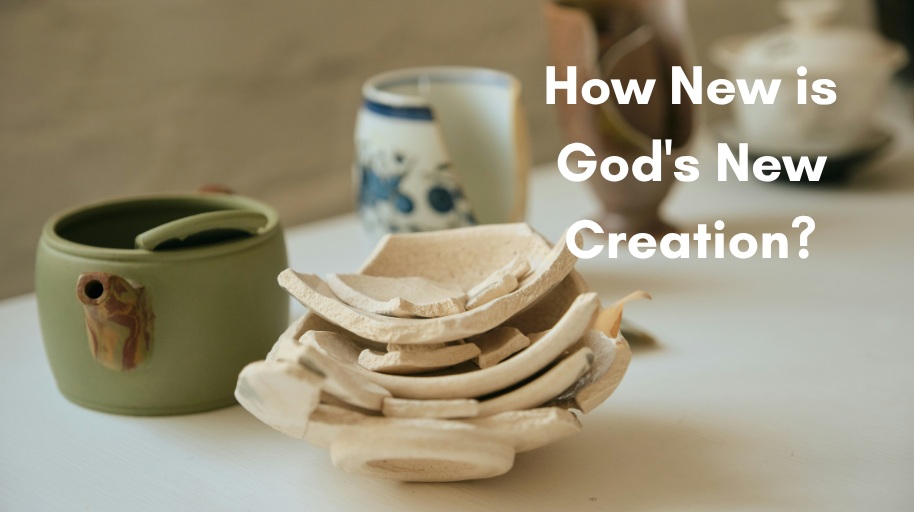
What about God’s creation? Clearly it is a seriously broken creation. And equally clearly, God is within his rights to throw it away and make a new, completely different creation. But my hunch is that he won’t do that. I think he will go down the restoration path. His plan is not to replace this world, but to renew it, to fix it, to make this world far better than it was at the beginning.
We could talk about the right interpretation of individual verses, but for me the heart of the creation story is the incarnation. Jesus is the divine sign that creation matters. Creation is worth saving. I am worth saving, and I am part of creation.
You see, if God’s solution to sin is a disposable throw-away creation, what happens to you and me? Is God going to throw me out with the rubbish and create a replacement for me? Personally, I don’t like the sound of that. I think that salvation as it applies to me means new life for me, the resurrection of me, healing and perfection for me. And yet I am truly a part of God’s creation. Why would the salvation of all creation not take place the same way?
The difference between a replacement car and a restored car is the level of connection to the car. It’s a matter of love, of passion. My ordinary car just gets me from A to B. When it can no longer do that, I just get a newer car. But the vintage enthusiast cares far too much for the old car to just throw it away. Instead, he will do everything in his power to make it new again.
So it is with the Repair Shop team. The restoration projects are all done for people who care desperately about that item. Maybe the item got them through a significant life crisis. Maybe it’s the only connection they have with a beloved family member. And just as the guests care deeply about the items, so the repair team cares deeply about the guests and will do whatever it takes to rescue and restore that which is cherished greatly.
God cares about his creation. He cares deeply. The evidence of that is that he himself entered this world in the life, death and resurrection of Jesus. He did so to bring healing to the world. Not just to me. Not just to you. But healing to all things. This whole universe, though currently broken in so many ways, will at last be restored, perfected, transformed, returned to the state it was in when first created at the beginning – before sin and evil corrupted it. Accordingly, (unlike the Repair Shop items) it will no longer be subject to any deterioration or decay (Romans 8:21).
What if we read those words from Revelation slightly differently? What if we imagined them saying:
He who was seated on the throne said, “I am rescuing everything from oblivion. Everything will be repaired, everything will at last be in mint condition!” Then he said, “Write this down, for these words are trustworthy and true.”
Peter Kirkpatrick
(Peter Kirkpatrick is a Trustee of New Creation New Zealand)