Genesis 1:28 isn’t a license to exploit creation. Discover why true biblical dominion means loving stewardship of the earth, not domination.
What Does “Dominion” Really Mean?
The “dominion” theory, that gives humans total domination over creation, is a theological view based on Genesis 1:28. It was interpreted during the 19th century to promote the Industrial Revolution and its desire to use the earth as malleable clay that humans could pound and shape into whatever they wanted. Wolfhart Pannenberg notes that it was only at the beginning of the nineteenth century that the dominion command was interpreted in terms of absolute human power over nature – just at the time “when modern humanity in its self-understanding was cutting its ties with the creator God of the Bible.” (1985: 78)
Lynn White’s Critique of Christianity
In 1967, Lynn White Jr. published an article called ‘The Historical Roots of our Ecologic Crisis’ in the Science journal. It argued that the application of the ‘dominion’ theory in the past is the cause of our ecological challenges in the present. This provocative article has become the most cited piece of writing within theological debate about the environment.
White argued that the Western Christian worldview supports and encourages humanity’s aggressive project to dominate and exploit nature. Previously, people had believed that spirits lived in objects such as trees and so thought that nature was sacred. Christianity swept away pagan animism and replaced it with the idea that all things were made for humanity’s ‘benefit and rule’ (p.1205). Humanity came to be seen as uniquely made in the image of God and as having ‘dominion’ or control over all the creatures of the earth (Genesis 1:26-30). Christianity, he asserts, normalized exploitation of the natural world because:
- The Bible asserts humanity’s dominion over nature and establishes a trend of anthropocentrism.
- Christianity makes a distinction between humans (formed in God’s image) and the rest of creation, which has no “soul” or “reason” and is thus inferior.
“…[Christianity] not only established a dualism of man and nature but also insisted that it is God’s will that man exploit nature for his proper ends… … Christianity made it possible to exploit nature in a mood of indifference to the feelings of natural objects… Man’s effective monopoly…was confirmed and the old inhibitions to the exploitation of nature crumbled” (p.1205).
White argued that “[Western] Christianity is the most anthropocentric religion the world has seen” (p.1205). He concludes that the modern technological conquest of nature has engendered the ecological crisis, and that this has, in large part, been made possible by the dominance in the West of this Christian world-view. At various times this view may have been held by the majority of Christians. Christianity therefore ‘bears a huge burden of guilt’ (p.1206). Many pundits believe that such indifference towards nature continues to impact in our industrial, “post-Christian” world.
White’s Call for a New Religious Vision
However, White does not think that secularism is the answer to our environmental problems. He does not want to reject Christianity but rather to radically change it. What people do about their ecology depends on what they think about themselves in relation to things around them. Human ecology is deeply conditioned by beliefs about our nature and destiny – that is, by religion.
“More science and more technology are not going to get us out of the present ecologic crisis until we find a new religion, or rethink our old one.”
Indeed, “We shall continue to have a worsening ecologic crisis until we reject the Christian axiom that nature has no reason for existence save to serve man” (p.1207). It is humanity’s fundamental ideas about nature that must change; we must abandon “superior, contemptuous” attitudes that make us “willing to use it [the earth] for our slightest whim.” (p.1206).
White (pp.1206-1207) appeals to the figure of Francis of Assisi as a potential “patron saint for ecologists”. He suggests adopting St. Francis of Assisi as a model in imagining a “democracy” of creation in which all creatures are respected and human rule over creation is delimited. In this way, White points to the potential for a renewed kind of Franciscanism – a spirituality that focuses on humanity’s kinship with all other creatures in a community of creation.
White’s ideas galvanized interest in the relationship between history, nature and the evolution of ideas, thus stimulating new fields of study like environmental history and eco-theology. They set off an extended debate about the role of religion in creating and sustaining the West’s destructive attitude towards the exploitation of the natural world. Some biblical scholars have questioned whether the technological developments that led to nature’s exploitation were really encouraged by the Christian world view.
Responses and Rebuttals to White
Wesley Granberg-Michaelson (1988: 33) delineates three flaws in White’s argument. These flaws are outlined by Bouma-Prediger (2010: 66-67):
- His summary of biblical teaching about the environment is selective and highly distorted,
- His contention that Christianity paved the way for the scientific and technological revolutions is questionable,
- and his assumption that environmental destruction has flowed solely from the mindset of western culture and not from others is dubious.
Alister McGrath believes that:
Lynn White is completely right when he argues that human self-centredness is the root of our ecological crisis, but quite wrong when he asserts that Christianity is the most anthropocentric religion the world has seen. The most self-centred religion in history is the secular greed of twentieth century Western culture, whose roots lie in the Enlightenment of the eighteenth century and whose foundation belief is that humanity is the arbiter of all ideas and values (2002: 54).
Equally, however, many saw his argument as a direct attack on Christianity, and other commentators think his analysis of the impact of the Bible, and especially Genesis, is misguided. They question whether the crucial texts in the Bible (especially in Genesis 1-2) really suggest the idea of human domination. They argue that Genesis provides man with a model of “stewardship” rather than dominion, and asks man to take care of the world’s environment. Such dominion is to be exercised with a responsibility to God and to be informed by love.
Pope Francis and Laudato Si’
Pope Francis I is a case in point. In chapter 2, Sections 66-68, of his landmark 2015 Encyclical Laudato Si’, he sees the “dominion’ view of Genesis 1:28 as distorted. It “has encouraged the unbridled exploitation of nature by painting him [man] as domineering and destructive by nature. This is not a correct interpretation of the Bible as understood by the Church.”
Christians, he urges, “must forcefully reject the notion that our being created in God’s image and given dominion over the earth justifies absolute domination over other creatures.”
Instead, Pope Francis does an exegesis of Genesis 2:15 telling Adam to till and tend the garden of the world. “’Tilling,’” writes Francis, “refers to cultivating, ploughing or working, while ‘keeping’ means caring, protecting, overseeing and preserving.” As a result, “Each community can take from the bounty of the earth whatever it needs for subsistence, but it also has the duty to protect the earth and to ensure its fruitfulness for coming generations.”
He notes that the Sabbath was a day of rest not only for humans but also for “your ox and your donkey” (Exodus 23:12). “Clearly, the Bible has no place for a tyrannical anthropo-centrism unconcerned for other creatures.” In fact, the psalms tell us that creatures by their very existence bless and give glory to God. God loves the work of his hands and saw that it was good even before man and woman were created.
Francis’ reflection on Genesis leads him to see that “human life is grounded in three fundamental and closely intertwined relationships: with God, with our neighbor and with the earth itself” These relationships are ruptured by sin, “by our presuming to take the place of God and refusing to acknowledge our creaturely limitations.”
We Don’t Own the Earth – God Does
In short, humans have overstepped the mark and usurped prerogatives that they were never given. It sometimes comes as a surprise to politicians, businesspeople, and other would-be claimants, to learn that we don’t actually own the earth. They may act as though “This place is ours. We’re in charge!” but they are mistaken.
Psalm 24:1 says: “The earth is the Lord’s, and everything in it.”
God owns it. What he said way back in Genesis 1 was this: “Okay, I own it, but I’m going to give you a certain amount of control and jurisdiction over what I own”. That’s why you find words those words “dominate, subdue, rule over”. However, as we have seen, they don’t mean “Treat it in whatever way you please.”
Tend and Keep: Our Nurturing Role
As pointed out by Pope Francis, in Genesis 2 God went on to define the nature of that jurisdiction. God took the man (representing humans) and put him in the Garden of Eden (representing the natural world) “to tend and keep it” I echo Pope Francis by again emphasising that “tend” means to cultivate, look after, dress, adorn. “Keep” means to exercise great care over, guard, preserve. It was very much a nurturing role.
In other words, right from the outset, humans were given permission to use the earth, but not to abuse it. We were appointed stewards. i.e. managers, caretakers, custodians. God took a risk. He entrusted what he had made to us and put us in charge of developing all the potentialities he built into it – wisely, faithfully, and in a timely manner. It is a God-given commission. And with that commission comes great responsibility – one day he will hold us accountable for how well we have carried it out.
Since God gave man the plants of the Garden of Eden for his benefit and told him to cultivate the ground (Genesis 2:5, 15), this implies that all of nature does not need to be kept in a totally wild state. This establishes a precedent that nature can be used for human benefit and modifications to the ecosystem, such as a dam or motorway, are not necessarily wrong, but a careful balance must be maintained.
Dominion in Love: A Summary
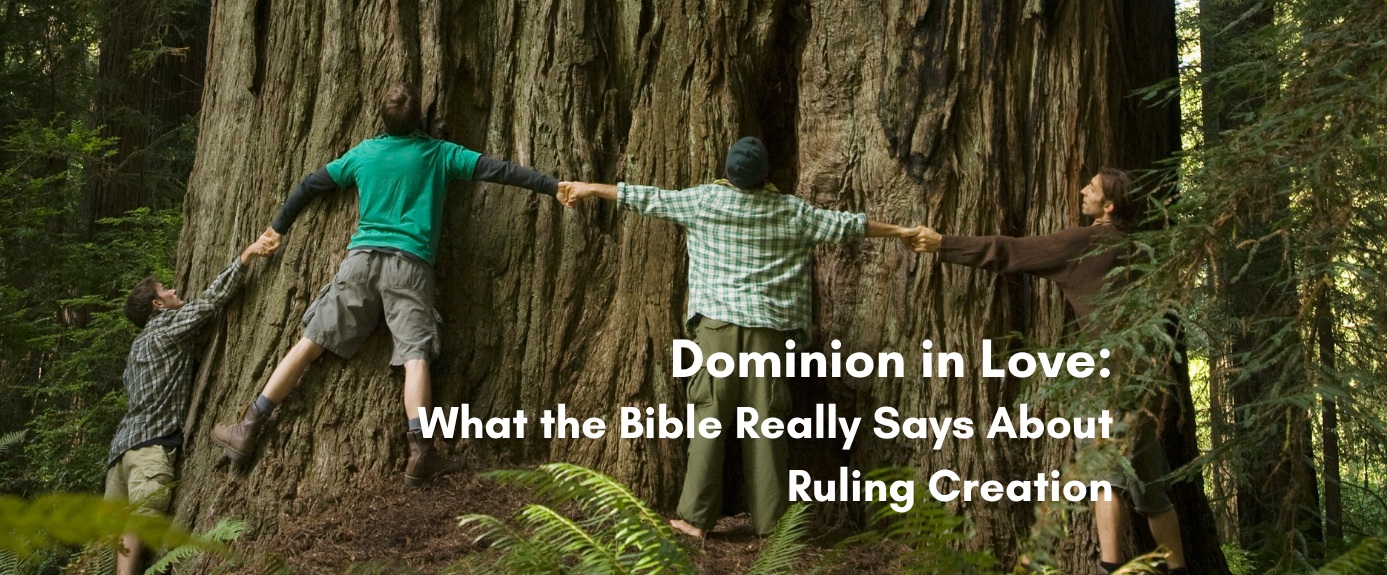
To sum up, it is essential that we understand the concept of dominion in context. Ken Gnanakan helps us to do this by explaining that God sanctioned a dominion in love (1999: 54-56):
- in love,
- within a commonality,
- with creativity,
- in servanthood,
- with stewardship,
- with respect
- and in justice.
Edward Brown adds:
Dominion – our rulership over the rest of creation – is simply the tool God has given us by which we can accomplish God’s goals, not our own, in creation. When we understand God’s purposes in creation properly, the apparent conflict disappears (2008: 50).
Dominion cannot be equated with either domination or exploitation. It is therefore incumbent on us as individuals, and as communities of faith, to carefully examine which agenda we are actually fostering and following, perhaps unwittingly. Is it one of domination and exploitation of the earth, or one of stewardship and sustainability? If the former, we must modify our behaviour accordingly and urgently.
Sources
- Brown, Edward R. 2008. Our Father’s World: Mobilising the Church to Care for Creation (Downers Grove, IL: IVP).
- Francis I (Pope). 2015. Praise be To You: Laudati Si’: On Care For Our Common Home (San Francisco, CA: Ignatious Press).
- Gnanakan, Ken. 1999. God’s World: A Theology of the Environment (London: SPCK).
- Granberg-Michaelson, Wesley. 1988. Ecology and Life: Accepting Our Environmental Responsibility (Waco, TX: Word).
- McGrath, Alister. 2002. The Reenchantment of Nature: The Denial of Religion and the Ecological Crisis (New York, NY: Doubleday).
- Pannenberg, Wolfhart. 1985. Anthropology in Theological Perspective (Philadelphia, PA: Westminster).
- White, Lynn. 1967. ‘The Historical Roots of our Ecologic Crisis’, Science, Volume 155, Issue 3767, 10 March: 1203-1207, reprinted in Robin Gill, 2006: A Textbook of Christian Ethics, 3rd edition (Edinburgh: T. and T. Clark), p.303ffg.
Questions for Discussion and Reflection
- How do you understand Genesis 1:28 in the light of Genesis 2:15?
- Do you agree with Lynn White that Christianity has fostered an exploitative and degrading approach to the created order?
- Is Alister McGrath right when he says: “The most self-centred religion in history is the secular greed of twentieth-century Western culture”?
- Discuss the practical implications of Ken Gnanakan’s statement: God sanctioned a dominion in love, within a commonality, with creativity, in servanthood, with stewardship, with respect and in justice.
- How does this teaching apply to you (find an application which is personal, practical and specific)?
Further Reading
- A Sense of Place (Part 2 of 3): Its Significance for the Individual – Discover the biblical and Māori roots of ‘sense of place’ and how knowing where you are shapes who you are.
-
A Sense of Place (Part 3 of 3): Its Significance for the Local Church – Explore why place and belonging matter for local churches, with seven practical ways congregations can ground ministry in their place.
The Other Great Commission Resource Pack
Discover ‘The Other Great Commission’ from Genesis 2:15—a full resource pack on biblical creation care for small groups & youth.
This turnkey ministry resource pack provides everything needed to teach and practice biblical creation care rooted in Genesis 2:15. It contains a deep theological essay framing environmental stewardship as humanity’s unrescinded calling, alongside a comprehensive small group study guide, a five-day personal devotional plan, and a family discussion sheet to bridge the gap between church and home.
For active ministry use, it includes a scripted ten-minute youth message with engaging object lessons, social media promotional templates, a practical community service project blueprint, and an expert theological reading list.
Ultimately, this comprehensive package offers leaders an effortless, biblically sound roadmap to move communities from passive consumption into proactive, faith-driven stewardship.
Phillip Donnell is the Director of New Creation New Zealand, which seeks to inspire and equip Christians to care for creation. Contact: phillipjohndonnell@gmail.com