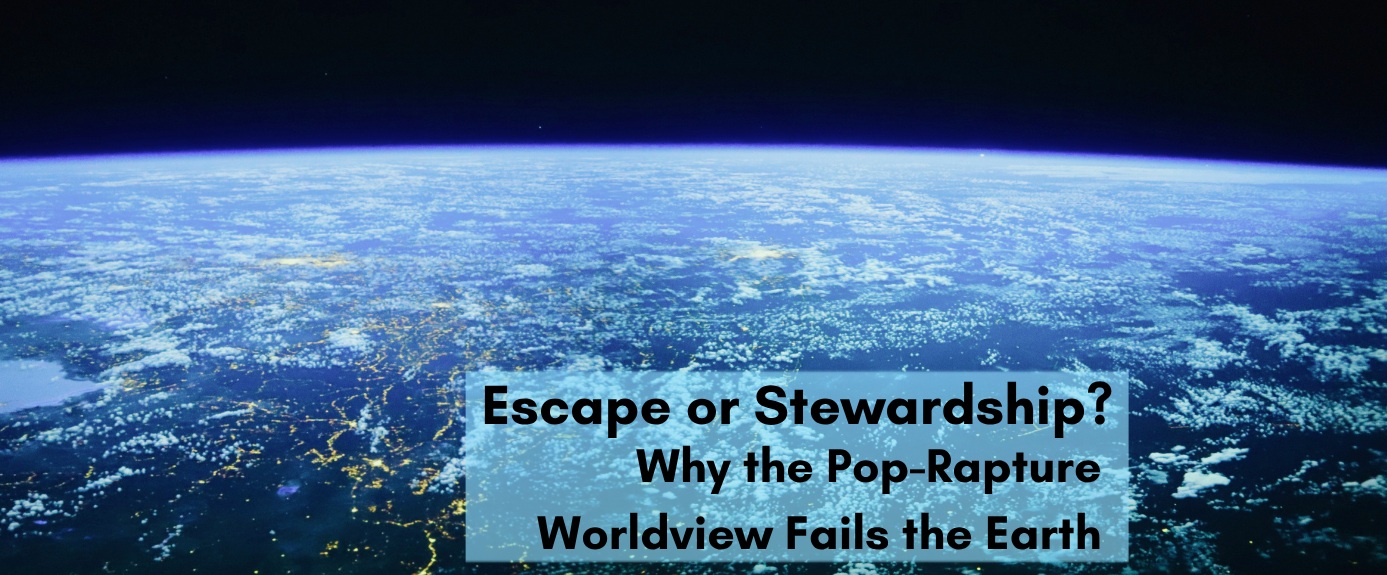
For nearly two centuries, a specific theological narrative has gripped a massive cross-section of modern Western Christianity: the pre-tribulation Rapture. Popularised by nineteenth-century theologian John Nelson Darby and catapulted into late-twentieth-century pop culture via books like Left Behind, this worldview insists that true believers will be secretly evacuated from Earth before a period of global cataclysm. While often dismissed as a fringe curiosity, this “Pop-Rapture” worldview has profound, real-world consequences, particularly regarding environmental policy and systemic apathy toward ecological collapse.
| Pop-Rapture Worldview | Creation Care Worldview |
| The Earth is a temporary, sinking ship. | The Earth is God’s sacred, ongoing creation. |
| Crisis is a “good sign” that Jesus is coming. | Crisis is a tragedy caused by human greed and sin. |
| Humanity’s goal is to escape the physical world. | Humanity’s goal is to steward and restore the physical world. |
Standing in stark opposition is the “Creation Care” movement, a theological framework that views environmental stewardship not as a political hobby, but as a foundational Christian duty. By contrasting these two paradigms, it becomes clear that the Pop-Rapture worldview is not only practically destructive, but fundamentally incorrect based on history, grammar, and the overarching narrative of Christian scripture.
The Architecture of Two Worldviews
The tension between these two views is rooted in entirely different assumptions about the ultimate destination of humanity and the purpose of the physical universe.
1. The Pop-Rapture Paradigm: The Disposable Planet
The Pop-Rapture worldview operates on a timeline of fatalistic escapism. It treats the physical universe as a temporary, disposable staging ground. In this framework:
- The Earth is fundamentally a sinking ship, or a house destined to be burned down by God’s impending judgment.
- Human responsibility is hyper-focused on saving individual souls before the cosmic rescue mission.
- Ecological degradation, resource depletion, and climate chaos are transformed from crises into “prophetic milestones.”
- Global instability is met with anticipation rather than mourning.
2. The Creation Care Paradigm: The Sacred Trust
Conversely, the Creation Care movement views the cosmos through the lens of a sacred covenant. Drawing from the Genesis accounts of creation, this perspective argues that the physical world belongs entirely to God (Psalm 24:1) and that humans were appointed as trustees or stewards, not destructive exploiters (Genesis 2:15). In this framework:
- The Earth is a sacred masterpiece that reflects the Creator’s glory.
- Environmental degradation is categorised as a symptom of human greed and sin.
- Preserving biodiversity, fighting pollution, and combating climate change are understood as acts of obedience to God and practical ways to love one’s global neighbours.
Why the Pop-Rapture Worldview Is Wrong
The fatal flaw of the Pop-Rapture worldview is that it relies on a cascade of historical innovations and structural misinterpretations of the biblical text. Scholars who refute the doctrine point out three primary reasons why this framework is fundamentally incorrect.
1. The Error of Historical Novelty
The first argument against the pre-tribulation Rapture is its complete absence from historical Christian orthodoxy. For the first 1,800 years of Church history, no major Christian tradition—including the Early Church Fathers, the medieval scholastics, or the Protestant Reformers—taught a two-stage return of Christ.
The concept was entirely unknown until John Nelson Darby formulated it in the 1830s to solve a highly specific theological puzzle regarding the relationship between the Church and national Israel. A doctrine that requires nearly two millennia of global Christian history to pass before being discovered stands on incredibly shaky theological ground.
2. The Grammatical Subversion of Text
Rapture theology falls apart when its foundational proof-texts are analysed in their original grammatical and cultural contexts. The most famous example is the misinterpretation of Matthew 24:40, which states that at the end of the age, “one will be taken and the other left.” Pop-theology depicts the one “taken” as the Christian being raptured to heaven. However, in the immediate preceding verses (vv. 37–39), Jesus explicitly compares this moment to the days of Noah, noting that the flood came and “took them all away.”
Contextually, the wicked were “taken away” in judgment and drowned, while Noah and his family were left behind to inherit, care for, and repopulate the cleansed earth. Grammatically and contextually, being “left behind” is actually the goal.
Similarly, 1 Thessalonians 4:17, which describes believers being “caught up… to meet the Lord in the air,” uses the Greek technical term apantesis. In the ancient Greco-Roman world, an apantesis was a formal delegation of citizens marching out of a city to meet an approaching king. Crucially, the citizens did not return to the king’s home with him; they met him in the open country to immediately escort him the rest of the way into their own city.
Paul’s original audience would have understood this imagery instantly: believers rise into the air as a welcoming committee to meet the descending King Jesus, immediately escorting Him down to Earth to establish His final kingdom. The directional movement of the text is ultimately downward, not an escape upward.
3. The Misunderstanding of the Cosmic Climax
Finally, Rapture theology completely misunderstands the final chapters of the Christian story. The Book of Revelation does not end with humans escaping the physical world to live on clouds in a disembodied heaven. Instead, Revelation 21 describes the New Jerusalem descending out of heaven to Earth, accompanied by a cosmic voice declaring, “God’s dwelling place is now among the people, and he will dwell with them.”
The New Testament consistently uses the Greek word kainos for the “New Earth,” which denotes something renewed and transformed in quality, rather than a brand-new planet created from scratch. Just as Noah’s flood purified the world rather than vaporising the physical globe, the final judgment is an act of purification and restoration. Trashing the planet because one expects a secret evacuation is a profound misunderstanding of the destination; humanity will live here, on a restored Earth, forever.
Conclusion: The Stakes of the Debate
The contrast between these two worldviews is not an abstract academic exercise. It carries immense real-world consequences for the future of the biosphere. The Pop-Rapture worldview breeds a toxic, fatalistic apathy, encouraging its adherents to exploit natural resources rapidly and disregard long-term ecological health under the assumption that the timeline is short and destruction is guaranteed.
The Creation Care movement corrects this error by reminding believers that the mandate to cultivate and protect the Earth was never rescinded. By restoring the biblical narrative to its historical, grammatical, and cosmic foundations, Creation Care demonstrates that true faith does not look for an escape hatch in the sky. Instead, it rolls up its sleeves to care for the Master’s estate, recognising that the Earth is not a disposable stage to be burned, but a sacred inheritance to be restored.
Further reading
-
Does the Bible tell us to care for Creation? – Explore the biblical call to care for the earth. Discover how Genesis 2:15 defines our sacred duty as stewards to serve and guard creation.
-
Will our present Earth be Annihilated or Transformed? – Does God destroy the earth or renew it? Explore the theology of transformation and why it makes creation care an essential Christian duty.
- What the Bible says about New Heavens and New Earth – Explore the biblical vision of the new heavens and new earth. Discover how God’s promise of renewal transforms our world and our lives today.