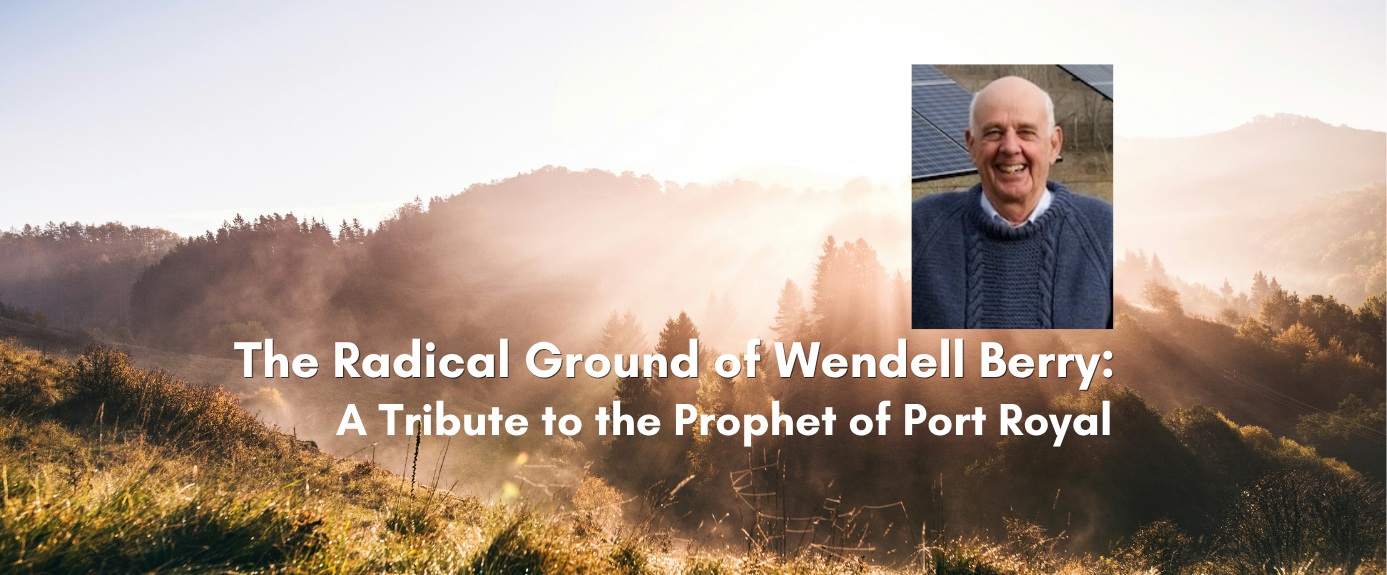
The passing of Wendell Berry on August 31, 2026, marked the departure of one of America’s most profound, stubborn, and luminous literary icons. A prolific poet, essayist, novelist, and farmer, Berry spent his 92 years wilfully out of step with the modern world.
While mainstream society sprinted toward automation, corporate globalism, and digital hyper-connectivity, Berry remained firmly rooted in the soil of Port Royal, Kentucky. He famously:
- refused to own a computer,
- wrote his masterpieces by hand or on a manual typewriter,
- and preferred the company of a team of working horses to the hollow promises of industrial progress.
He was a man who did not merely critique modern life; he looked at it, politely declined its terms, and went back to digging a ditch.
In a culture obsessed with scale and speed, Berry’s life was an extended masterclass in the radical art of staying put. He understood that you cannot love the world in the abstract; you can only love it in the specific. His staggering body of work—spanning more than 50 books—serves as a map for human survival, charting a way back to sanity through a deep, uncompromising reverence for the land, community, and the dignity of good work.
Part I: The Pillars of an Agrarian Vision
To read Wendell Berry is to be confronted by a series of beautifully simple, yet deeply challenging, principles. At the heart of his philosophy is agrarianism, a worldview that sees the earth not as a collection of raw materials to be extracted for profit, but as a sacred gift to be tended with humility and care.
1. Radical Interconnectedness
Berry rejected the modern fragmentation that separates the consumer from the producer, and the human from the ecosystem. In his landmark 1977 book, The Unsettling of America, he argued that treating the land as a commodity ultimately degrades the human soul. He wrote:
“The care of the Earth is our most ancient and most worthy, and after all our most pleasing responsibility. To cherish what remains of it and to foster its renewal is our only hope.”
2. The Sacredness of Place and Fidelity
In an era where geographic mobility is prized as a metric of success, Berry championed the unfashionable virtue of staying home. He believed that true stewardship requires long-term commitment. If you plan to move every few years to chase a corporate promotion, you will never care enough to plant an orchard or preserve the topsoil. For Berry, fidelity to a place, a spouse, and a community were all cut from the same cloth.
3. Appropriate Technology and the Question of “Enough”
Berry was not a Luddite who hated machines; he was a pragmatist who hated what machines did to human communities. He argued that we must evaluate technology based on what it destroys, not just what it creates. In his classic essay Why I Am Not Going to Buy a Computer, he noted that he refused to trade his wife’s editing help and a pencil for a machine made by an exploitative corporation. He forced us to face the ultimate ecological question:
“We learn from our gardens to deal with the most urgent question of the time: How much is enough?”
4. The Dignity of Physical Labour
Modern economy treats physical labour as a curse to be automated away. Berry saw it as a source of profound joy and spiritual discipline. He believed that working with your hands connects you to the reality of creation. Good work is not merely a job; it is an act of love and neighbourliness.
Part II: The Serious Art of Living Lightly
Though Berry was a fierce polemicist who took the degradation of rural life seriously, he was never a humourless scold. His writing sparkles with a dry, agrarian wit that targets the absurdities of modern “smart” living. He took great pleasure in poking the bear of corporate efficiency, capturing the inherent comedy of a humanity that has become too clever for its own good.
In his poem Manifesto: The Mad Farmer Liberation Front, Berry gives us a masterclass in joyful, subversive defiance:
“Deny the power of money to give joy to what is separately bought. / Ask the questions that have no answers. / Invest in the millenium. Plant sequoias. / Say that your main crop is the forest that you did not plant, / that you will not live to harvest.”
There is a quiet comedy in his essays when he describes the technological utopianism of his contemporaries. He observed how modern people willingly trap themselves in cubicles, staring at screens all day, in order to earn money to buy packaged food that tastes like cardboard, all while calling it “progress”. Berry’s humour was always rooted in common sense. He recognised that a society which can fly to the moon but cannot feed its own people without poisoning its water supply is, fundamentally, a ridiculous society.
His fiction, particularly his stories of the fictional town of Port William, Kentucky, is filled with the warm, gentle humour of eccentric neighbours. He understood that human beings are deeply flawed, occasionally stubborn, and endlessly complicated creatures who are saved not by grand political theories, but by local affection and mutual toleration.
Part III: The Activism of “Direct Action”
While the cultural imagination often pictures Berry as a serene, gentle poet strolling through sun-dappled pastures, his environmentalism was forged in the fires of fierce, uncompromising confrontation. Berry was not an armchair philosopher; he was an unflinching environmental activist who repeatedly risked his comfort, his reputation, and his freedom to protect the earth. He believed that words were useless if they were not backed by physical presence.
- The Capitol Sit-In against Mountaintop Removal: In 2011, at 76 years old, Berry joined 13 other activists in a four-day sit-in at the Kentucky Governor’s office. They were protesting mountaintop-removal coal mining, a practice that blasts away ancient Appalachian peaks, choking local streams with toxic debris. Reflecting on the event with his characteristic dry humour, Berry noted that despite the political gridlock, it was one of the best weekends of his life because of the “unlikely characters” he bonded with, proving that even a protest could foster a community.
- Pulling Papers from the Kentucky Historical Society: In 2010, Berry dynamically protested the University of Kentucky’s decision to accept a $7 million donation from the coal industry to fund a wildcats basketball dorm named after a coal magnate. Infuriated by the institutional selling-out to big energy, Berry withdrew his personal archives and papers from the university, stating he could no longer entrust his life’s work to an institution complicit in the destruction of Kentucky’s landscape.
A Critique of Mainstream Environmentalism
Berry was highly critical of mainstream environmental movements. He argued that modern environmentalists were often too focused on saving “pristine wilderness” while completely ignoring the spaces where humans actually live and work. In his sharp, foundational essay Think Little, he admonished those who attended massive climate marches but couldn’t be bothered to grow a single tomato:
“A protest meeting on the issue of environmental abuse is not a convocation of accusers, it is a convocation of the guilty… Nearly every one of us, nearly every day of his life, is contributing directly to the ruin of this planet.”
For Berry, global environmental activism was meaningless without local accountability. He famously warned that focusing strictly on global metrics like “climate change” allowed people to overlook immediate, historical land abuse right in front of them, such as topsoil erosion and chemical runoff. His activism was fundamentally an act of defiance against the “total economy”—a system where corporations dictate terms to the earth. In a rare, fiery interview with Bill Moyers, the usually quiet farmer gave a chilling directive to the environmental movement:
“People who own the world outright for profit will have to be stopped; by influence, by power, by us.”
Part IV: The Sacramental Soil—The Intersection of Faith and Ecology
To truly understand Berry’s environmental activism, one must understand that for him, ecology and theology were inseparable. He did not view the earth through the lens of modern secular political movements; he viewed it as God’s creation, a sacred masterpiece entrusted to human hands. Berry’s lifelong faith undergirded his activism, positioning him as a foundational architect of the global “creation care” movement.
The Rejection of “Dominionism”
Berry was frequently a thorn in the side of conventional American religion. He fiercely opposed dominionism—the theological interpretation of Genesis 1:28 used by some prominent Christians to argue that humans have a God-given right to exploit, conquer, and strip-mine the earth for corporate profit. Instead, Berry pointed squarely back to Genesis 2:15, pointing out that humanity was placed in the garden to “dress it and keep it”. He famously observed:
“We are allowed to make no exceptions – every person’s obligation toward creation is summed up in two words from Genesis 2:15: ‘Keep it.'”
To destroy a mountainside for coal or to poison a river with pesticide wasn’t just bad policy to Berry; it was blasphemy against the Creator.
The Humour of the “Unconventional Baptist”
While theologians and seminarians treated him like a prophet—with crowds parting like the Red Sea when he walked into religious conferences—Berry’s day-to-day spiritual life was practical and deeply independent. He was a lifelong Baptist, but his devotion was beautifully unconventional.
On Sunday mornings, while his beloved wife, Tanya, played the piano for the local congregation, Berry could often be found skipping church to walk into the woods. He joked that he was simply practising a different kind of liturgy. These solitary, Sunday morning truancies directly birthed his famous Sabbath Poems, a decades-long collection of spiritual verses written while observing the holy architecture of the trees. He found a hilarious irony in a religious establishment that built massive, air-conditioned megachurches to praise God on Sundays, while paving over God’s actual, living world during the rest of the week.
For Berry, the ultimate sin of modern capitalism was that it treated the world as “dead stuff”—mere raw materials to be used up. His faith provided a “sacramental vision,” a belief that everything from the topsoil to the working horse is a physical container of divine love. He summarised this beautifully in his poetry:
“The world is a holy vision, had we clarity to see it.”
Part V: A Living Legacy
Wendell Berry’s legacy is not a monument built of stone; it is a landscape of ideas that continues to bear fruit. Decades before the farm-to-table movement became a trendy urban phenomenon, Berry was laying the intellectual foundations for sustainable agriculture, localism, and regenerative farming.
His legacy operates on three distinct levels:
- The Literary Inheritance: Berry proved that writing is a form of work that demands honesty, economy of language, and moral gravity. His poetry, especially classics like The Peace of Wild Things:
“When despair for the world grows in me / and I wake in the night at the least sound / in fear of what my life and my children’s lives may be, / I go and lie down where the wood drake / rests in his beauty on the water, and the great heron feeds. / I come into the peace of wild things / who do not tax their lives with forethought / of grief.”
- The Institutional Work: Through The Berry Centre in New Castle, Kentucky, his family and advocates continue to put his words into economic action. The centre champions small-scale farmers, runs local cooperatives for grass-fed agriculture, and works to ensure that rural communities are not entirely swallowed by industrial monopolies.
- The Culture of Return: His greatest legacy is the generation of young farmers, urban homesteaders, writers, and activists who read his essays and decided to change their lives. Because of Wendell Berry, thousands of people have chosen to buy smaller homes, plant backyard gardens, support local businesses, and commit themselves deeply to their neighbourhoods.
In the Grace of the World
Wendell Berry did not expect to save the world single-handedly, nor did he believe that human progress was an unstoppable march upward. He understood that the real work of living well is quiet, repetitive, and largely invisible. He taught us that when the macro-economy fails and the political landscape grows toxic, the solution is always local: tend your garden, love your neighbour, do good work, and learn to be still.
He has returned at last to the Kentucky earth he defended so fiercely, leaving behind a magnificent, towering testament of words. We are left with his instructions, his poetry, and his challenge to slow down, look at the soil beneath our feet, and remember what people are actually for.
CURATED READING LIST
Here is a curated reading list of Wendell Berry’s vast body of work, organised by genre and entry point to help you navigate his extraordinary legacy.
🌱 The Essential Philosophy (Essays)
If you want to understand his core arguments regarding agrarianism, economy, and environmental activism, start here.
The Unsettling of America: Culture & Agriculture (1977)
- What it is: His magnum opus of non-fiction.
- Why read it: It is a fierce, prophetic critique of industrial farming and corporate disconnection. It remains the foundational text for the modern sustainable agriculture movement.
What Are People For? (1990)
- What it is: A highly accessible collection of essays.
- Why read it: It contains some of his most famous and biting short pieces, including Why I Am Not Going to Buy a Computer and Waste, which brilliantly showcase his dry common sense and agrarian wit.
The Art of the Commonplace: The Agrarian Essays (2002)
- What it is: A comprehensive, single-volume collection of his best agrarian writings.
- Why read it: If you only buy one book of his essays, make it this one. It neatly organises his thoughts on community, body, soul, and economics.
The Membership of Port William (Fiction)
Berry spent decades writing interconnected novels and short stories about the fictional rural community of Port William, Kentucky.
Nathan Coulter (1960)
- What it is: Berry’s very first novel.
- Why read it: A beautiful, slim coming-of-age story that introduces the geography and early characters of the Port William “membership.”
Jayber Crow (2000)
- What it is: Widely considered his fictional masterpiece.
- Why read it: Written from the perspective of the town barber, this sprawling novel captures the transformation of rural America across the 20th century. It is a profound, deeply moving exploration of unrequited love, fidelity to place, and community survival.
Hannah Coulter (2004)
- What it is: A novel told from the perspective of an elderly widow twice-married to Port William farmers.
- Why read it: It offers the most beautiful window into the concept of “the membership”—Berry’s term for a community that willingly looks after its own through generations of grief, joy, and hard work.
The Peace of Wild Things (Poetry)
Berry’s poetry is quiet, grounded, and serves as a perfect antidote to modern anxiety.
Selected Poems of Wendell Berry (1998)
- What it is: A curated overview of his early and mid-career poetry.
- Why read it: It contains his most famous and beloved poem, The Peace of Wild Things, alongside Manifesto: The Mad Farmer Liberation Front.
This Day: Collected & New Sabbath Poems (2013)
- What it is: A massive collection of the poems he wrote on Sunday mornings while walking through the woods instead of sitting in a church pew.
- Why read it: This is where his theology and his deep love for the natural world explicitly intersect. It reads like a slow, rhythmic devotional to creation.
The Recommended Trajectory
- For the absolute beginner: Start with the novel Hannah Coulter or his Selected Poems to fall in love with his voice and his world.
- For the environmental activist: Dive straight into the essay collection What Are People For?, specifically the essay Think Little.
- For the deep dive: Commit to the sweeping narrative of Jayber Crow.
Further reading
- Jesus and the Natural World: A Biblical Call to Creation Care – How did Jesus view nature? Explore His teachings on birds, lilies, and seeds, revealing a biblical mandate for creation care today
-
Even More Need for the Sabbath: Why Rest Still Matters – The Sabbath is more than rest: it renews people, honours creation, and is even tracked from space as NASA’s Sabbath effect.
-
A Manifesto for Local Conservation – Reject the myth of a disposable planet. Discover actionable, localized ways to steward and restore the physical creation God loves.
Rev. Phillip Donnell, Director/Team Leader of New Creation New Zealand (NCNZ), has spent 20+ years in Christian environmental leadership. Former pastor and teacher, published author, Forest & Bird Life Member. Based in Tauranga.