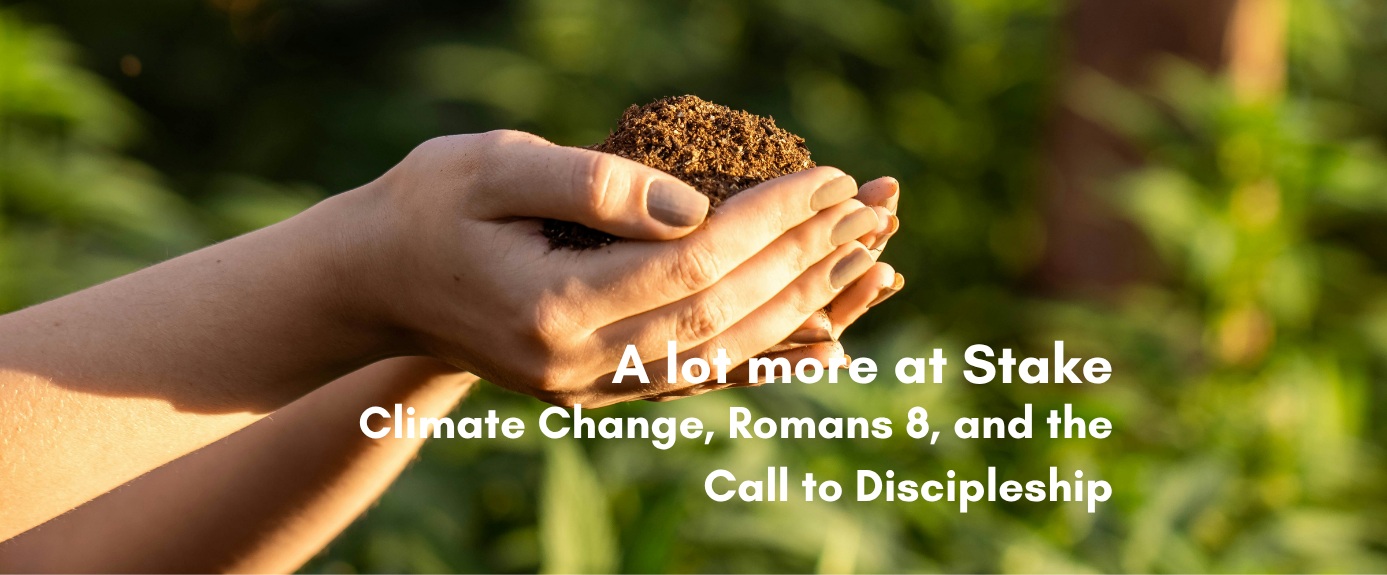
Explore how Jesus’s death connects to climate justice, Romans 8, and the call for Christians to choose discipleship over denial.
When Jesus was crucified on a stake in Jerusalem, very few realised that there was a lot more at stake than just jealous religious leaders asserting their authority or egotistical political rulers preserving their pride. The ultimate redemption of the entire created order, both human and non-human, was focussed in that one place at one point in time. The eternal and far-reaching implications of his death and resurrection were yet to unfold. Indeed, they are ongoing and have yet to be culminated.
What Was Really at Stake at the Cross
Beyond Religious and Political Power Struggles
The crucifixion is often remembered as a clash of religious authority and political ambition. But underneath that surface-level conflict lay something far larger — the fate of creation itself.
The Redemption of Human and Non-Human Creation
Christ’s death and resurrection set in motion a redemption that reaches beyond individual salvation, extending to the whole created order — a theme this article traces through to its ecological and economic implications today.
Paris 2015 — A Bigger Opportunity Than Climate Alone
The United Nations Climate Change Conference (UNCCC, or COP 21) took place in Paris from November 30 to December 11 in 2015. It presented, arguably, the last opportunity for political leaders from around the world to achieve a legally binding and universal agreement on climate, with the aim of keeping global warming below the 2°C essential for the future health of the planet.
Some, however, were aware that a lot more was at stake. They were the ones who made the connection between the carbon in the air and the entire economic system which put it there, and realised that those twelve days could also set the world on a new path that has the potential to transform our failed systems.
Naomi Klein’s Vision: “This Changes Everything”
Naomi Klein, for example, is “convinced that climate change represents an historic opportunity on an even grander scale.” She forcefully explores this notion in her 2014 book This Changes Everything: Capitalism vs The Climate, and more recently in the accompanying film screened across the globe. Her assertion is that “As part of the project of getting our emissions down to the levels many scientists recommend, we once again have the chance to advance policies that dramatically improve lives, close the gap between rich and poor, create huge numbers of good jobs, and reinvigorate democracy from the ground up…transformations that would leave us with both a more habitable climate than the one we are headed for now and a far more just economy than the one we have now… Put another way, if there has ever been a moment to advance a plan to heal the planet that also heals our broken economies and our shattered communities, this is it.” (pages 10, 155).
Andrew Cutler and Forest & Bird NZ’s Call for Change
A growing number of people are reaching the same conclusion. Closer to home is Andrew Cutler, President of Forest and Bird NZ, whose editorial in their Summer 2015 magazine was headed “Time for a change.” He wrote: “While we have made progress on many environmental and conservation issues, there is still an unwillingness by economic and political leaders to acknowledge the central problem behind the ongoing damage we are doing to our world: that much of our present economic system is ecologically unsustainable…causing the permanent loss of species, landscapes and our natural environment.” He calls on business and government to make such an acknowledgement, so that “with the denial behind us, we can begin the positive task of…creating an economy that enriches our communities and our natural world.” Cutler’s call is supported by a practical and plausible strategic plan.
Change the System, Not Just the Climate
Alternatiba, a citizens’ collective in France, has the rallying cry: “Change the System, not the Climate.” I believe that the work of our time is much bigger than climate change. Yes, we should continue to exert pressure to ramp up renewables, cut coal use, invest heavily in energy efficiency, chop fossil fuel subsidies, and reduce greenhouse gas emissions by any other means. But we also need to be setting our sights higher and deeper.
Why Climate Change Could Be a Galvanising Force
Climate change “could become a galvanising force for humanity, leaving us all not just safer from extreme weather, but with societies that are safer and fairer in all kinds of other ways as well… It is a vision in which we collectively use the crisis to leap somewhere that seems, frankly, better than where we are right now.” (Klein, 2014: 7).
Questioning the Mantra of Continuous Growth
It is not an impossible dream, but it is one that requires each of us, in the aftermath of Paris and similar gatherings since, to question the status quo, particularly the mantra of continuous economic growth at the expense of environmental degradation, and together strive for something markedly different in the years to come.
A Watershed Moment: Denial or Discipleship
The ecological endgame that stalks our history puts humanity in a watershed moment that demands serious, sustained engagement from Christians; we must choose between denial and discipleship. Both our love for the Creator and the interlocking crises of global warming, peak “everything,” and widening ecological degradation should compel us to make environmental justice and sustainability integral to everything we do as disciples — and as citizen inhabitants of specific places. This requires us to embrace deep paradigm shifts and broad practical changes of habit in our homes, churches, and denominations.*
Romans 8:20 — Creation’s Enslavement and Liberation
Conferences come and go, but people power achieves much more in the long term. It is time to embrace the vocation envisioned by the Apostle Paul: the “children of God” must take a stand of passionate solidarity with a Creation that is enslaved to dysfunctional and toxic civilizational lifestyles, and commit themselves to the liberation of the earth and all its inhabitants (Romans 8:20f).
Practical Paradigm Shifts for Homes and Churches
It will be a great day when others from around the world visit us to learn of the great progressive steps we have put in place in New Zealand. Will you be part of the growing movement for change?
Related reading:
- Agents of Liberation: Embracing Our Romans 8 Mandate Today Discover our Romans 8 mandate to become agents of liberation, breaking creation’s bondage to decay through holistic eco-justice.
- A Manifesto for Local Conservation Reject the myth of a disposable planet. Discover actionable, localized ways to steward and restore the physical creation God loves.

- Core Theological Tenets of the Creation Care MovementCreation Care theology’s biblical case for stewardship, dominion reinterpreted, cosmic redemption, and loving neighbour through justice.