The scope of Christian redemption is frequently reduced to a strictly individualised, anthropocentric transaction—a rescue mission designed exclusively to extract human souls from a corrupt world and secure them a place in a distant, disembodied heaven.
However, the New Testament presents a radically grander vision of salvation, one that encompasses the entire cosmos.
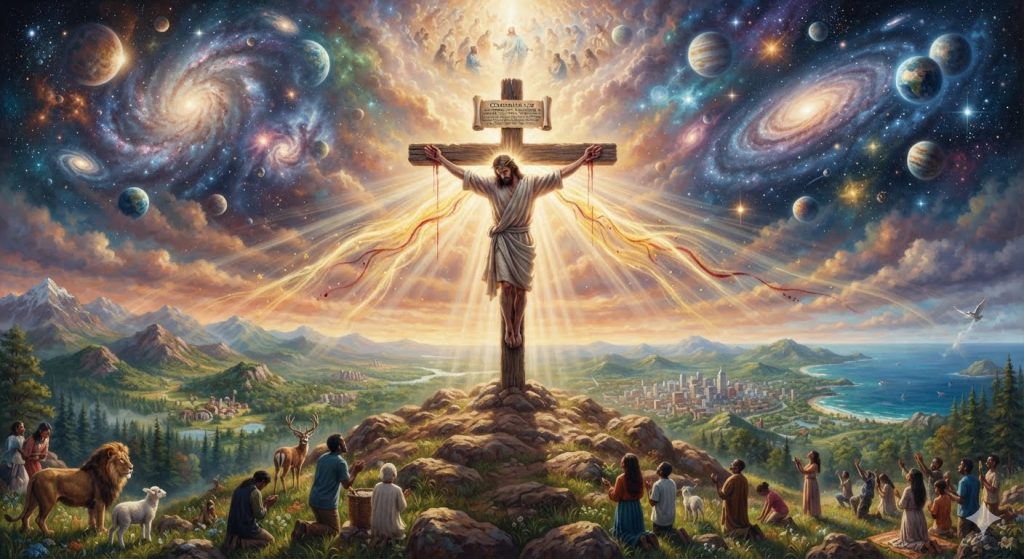
At the heart of this expansive theology stands Colossians 1:20, where the Apostle Paul declares that through Christ, God chose “to reconcile all things to himself, whether things on earth or things in heaven, by making peace through his blood, shed on the cross.”
By utilising the sweeping phrase “all things” (ta panta), Paul explicitly links the redemptive work of the cross to both the human and non-human creation. This cosmic reconciliation carries profound implications for understanding the ultimate destiny of the universe and fundamentally transforms our present attitudes and actions toward the natural world.
Reconciliation for Humanity
To fully grasp the implications of Colossians 1:20, one must first explore what it means for human creation.
For humanity, reconciliation addresses the deep spiritual, psychological, and relational alienation caused by sin. Human beings, designed to bear the divine image and act as benevolent stewards of the earth, instead chose autonomy, resulting in a fractured relationship with their Creator, internal brokenness, and systemic injustice within society.
The blood of the cross provides the legal and relational basis for forgiveness, justification, and spiritual rebirth. It restores human beings to their rightful status as children of God and initiates a process of internal renewal.
However, human reconciliation is not an end in itself; rather, it is the restoration of the priesthood of humanity, repairing the fractured link between the Creator and the wider created order.
Reconciliation for All Creation
Crucially, Paul does not limit this reconciliation to human beings. The text explicitly extends the scope of the cross to “things on earth or things in heaven” through his precise linguistic choice of the Greek phrase ta panta.
Translating literally to “the all,” this technical philosophical term denotes the entire cosmic whole as a single, integrated unit, leaving nothing outside its boundaries.
By establishing that ta panta is created by Christ, sustained by Him, and now reconciled through Him, Paul confirms that the material universe—including animals, forests, oceans, and atmospheres—possesses intrinsic value to God.
The non-human creation does not experience personal guilt, yet it suffers the collateral damage of human mismanagement, remaining subjected to a bondage of decay.
Colossians 1:20 affirms that the material cosmos is not a disposable backdrop destined for ultimate annihilation, but an object of God’s redeeming love, guaranteed a future of purification, renewal, and liberation.
Dismantling the Sacred-Secular Divide
This robust theology of cosmic reconciliation carries immediate, paradigm-shifting implications for our present attitudes.
It forcefully dismantles the sacred-secular dualism that has plagued Christian thought for centuries—a dualism that elevates the spiritual while denigrating the material as inherently evil or worthless.
When we recognise that Christ shed His blood to reconcile “all things,” we can no longer view the earth as a temporary commodity to be ruthlessly exploited before being discarded.
Our attitude shifts from arrogant ownership to humble, temporary stewardship. We begin to see the natural world through a Christological lens, recognising that every mountain, river, and species matters to its Creator.
From Attitude to Action
Consequently, these altered attitudes must manifest in concrete, daily actions.
If the ultimate trajectory of God’s mission is the reconciliation and renewal of all things, then the current actions of His followers ought to reflect that future reality. Christian lifestyle and engagement should serve as an intentional signpost pointing toward the coming new creation.
This provides a powerful theological foundation for active environmental stewardship and ecological care. Rather than viewing conservation as a secular, political distraction, Christians can embrace it as an act of worship and a direct expression of discipleship.
Living It Out
In practice, living out the reality of Colossians 1:20 means:
- Actively resisting the destructive forces of environmental degradation and unchecked consumerism
- Making conscious, ethical decisions regarding energy consumption, waste reduction, and resource management
When a community protects an ecosystem, restores a polluted waterway, or advocates for sustainable agricultural practices, they are performing an anticipatory act.
They are declaring to the world what the cross has already secured in principle: that the material world matters to God and will one day be perfectly restored.
Furthermore, because human suffering and environmental degradation are inextricably linked—with the poorest global communities often bearing the brunt of pollution and climate instability—caring for non-human creation becomes a vital component of loving our human neighbours.
A Holistic Faith
Ultimately, Colossians 1:20 calls for a holistic faith that refuses to separate the gospel from the ground beneath our feet.
The cross of Jesus Christ is large enough to encompass both the salvation of the human soul and the restoration of the physical cosmos.
By aligning our present perspectives and behaviours with this expansive biblical vision, we cease to live at odds with the world God loves. Instead, we become active participants in His grand, redemptive project, demonstrating through our care for both human and non-human creation that the peace made through the blood of the cross is already breaking into the present age.
Related posts:
- Core Theological Tenets of the Creation Care Movement Creation Care theology’s biblical case for stewardship, dominion reinterpreted, cosmic redemption, and loving neighbour through justice.

- Agents of Liberation: Embracing Our Romans 8 Mandate Today Discover our Romans 8 mandate to become agents of liberation, breaking creation’s bondage to decay through holistic eco-justice.

- What the Bible says about the Renewal of the Cosmos Discover the biblical promise of cosmic renewal. Explore how God transforms and restores the world through the redemptive work of Christ.