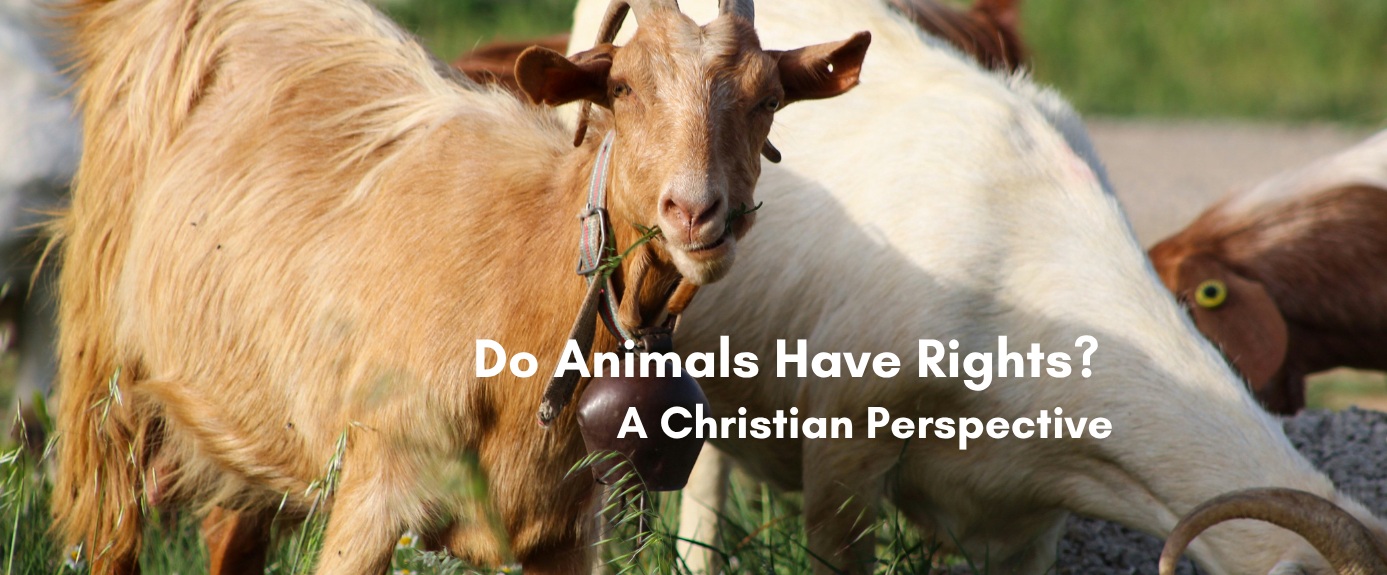
Do animals have rights? Explore the rights-vs-welfare debate and how Christian theology has grown more sympathetic to animals
Why This Question Matters Now
In today’s world, human-animal relationships lie at the heart of many of our most pressing social, economic, geographical, and environmental challenges. Science is increasingly making us aware of how dependent we are on the non-human creation. The health of the planet, and so our own health, is deeply enmeshed with the well-being of fish, birds, mammals and invertebrates. Issues of ecological sustainability, equity and responsibility are involved. The ways we treat animals play a major role in this emerging ethic. There is a growing movement in the western world to think about our relationship with animals more carefully than in the past.
Jimmy Stewart’s Testimony and Popular Culture
In the early 1990s, the famous actor Jimmy Stewart testified before a special committee of the U.S. Congress, drawing attention to the unnecessary and unwarranted torturing of animals in the cosmetic industry. He said,
“It is wrong for animals to have to endure such suffering to provide makeup for women.”
His testimony not only drew attention to the fact that humans sometimes make animals endure incredible pain without sufficient justification, but also focussed attention on animal ethics and whether animals have rights. The movies Babe, Beethoven, 101 Dalmatians and Lost World added fuel to the fire. The main controversies are experiments on animals, rearing and killing animals for food, hunting, entertainment, zoos and pet-keeping.
Animal Rights vs Animal Welfare
The difference between animal rights and animal welfare may be summed up like this:
Animal rights advocates are campaigning for no cages while animal welfarists are campaigning for bigger cages.
Animal rights supporters believe it is morally wrong to use or exploit animals in any way and that humans should not do so, whereas animal welfare supporters believe it can be morally acceptable as long as suffering is eliminated or minimised and there is no other practicable way of achieving the same end. For welfarists, reducing the suffering reduces the wrong that is done but for rights advocates doing wrong things humanely does not make them any less wrong.
The Case for Animal Rights
The animal rights camp believes that animals have biological complexity, sentient characteristics and inherent value, therefore they have rights that must be respected. It is not a case of mere paternalism. There are certain things humans should not do, regardless of the cost, because doing them would violate such rights.
In an essay contained in the ground-breaking Animals, Men and Morals (1971), Brigid Brophy was adamant that once we acknowledge life and sentiency in the other animals, we are bound to acknowledge what follows: the right to life, liberty and the pursuit of happiness.
No-one, however, seems to suggest that animals should have all the same rights as human beings, or that all animals should have rights – the question is where to draw the line. Within this movement are those who advocate:
- full rights,
- some rights, or
- merely the right to humane treatment.
The Case Against Animal Rights
Opponents say that animals should not be accorded rights because they don’t think, are not really conscious, were put on earth to serve human beings, don’t have souls, and don’t behave morally. Moreover, the consequences are so limiting for humanity, to give rights to very simple creatures defies common sense, and the argument for them to be treated properly can be based entirely on the need for humans to behave morally. They assert that animals can be used for the benefit of humans providing some thought is given to their interests and under appropriate circumstances. Opinions vary as to what constitutes ethical treatment.
Contemporary Christian Thinking
Contemporary Christian thinking is largely sympathetic to animals. While most theologians struggle with the idea that animals have rights, they do acknowledge that animals show sufficient consciousness and self-awareness to deserve moral consideration.
The leading modern Christian writer on animal rights is Andrew Linzey who wrote Christianity and the Rights of Animals in 1987. He believes that since an animal’s natural life is a gift from God, it follows that God’s right is impugned when the natural life of his creatures is perverted. God’s love, he says, is not just for human beings but for all creatures. Doing wrong to an animal is wronging God by violating his right to have the whole of his creation respected. Christians should treat every animal according to its intrinsic God-given worth, and not merely its usefulness. Christians who do this will achieve a much greater spiritual appreciation of the worth of creation.
The Anglican Position (Lambeth 1998)
The Anglican view was enshrined in a resolution from the 1998 Lambeth conference. It affirmed four principles:
- first, creation is a web of inter-dependent relationships bound together in a covenant which God has established with the whole earth and every living being;
- second, the divine Spirit is sacramentally present in creation, which is therefore to be treated with reverence, respect and gratitude;
- third, humans are co-partners with the rest of creation, with responsibility to make personal and corporate sacrifices for the common good of all creation;
- and lastly, the redemptive purpose of God in Jesus Christ extends to the whole of creation.
The resolution is low on specifics or examples.
A Shift from Dominion to Stewardship
The growth of the environmental movement has substantially changed Christian ideas about the role humans play in relation to nature. Few Christians nowadays think that nature exists merely to serve humanity, and there is a general acceptance that human jurisdiction over nature should be seen as stewardship and partnership rather than dominion and exploitation. Tony Campolo represents the view of a growing number when he says:
Only those who do not consider the feelings of animals can kill them for fun. Only those who sense nothing “holy” about the forests and the plants can destroy them with little concern. Only those who do not sense the stars and galaxies declaring the glory of God can be indifferent to the pollution that hides them from view. – Tony Campolo (1992: How to Rescue the Earth Without Worshiping Nature, page 29)
Toward a Peaceable Kingdom
The “peaceable kingdom” that the theologically-sensitized advocates of animal rights believe the Messiah is yet to usher in, will be one in which the oppression of animals will end. Such notions have significantly softened Christian attitudes to animals. It remains for the individual to translate them into practice.
* For an expansive discussion of this issue, see www.bbc.co.uk/ethics/animals
Phillip Donnell is the Director of New Creation New Zealand, which seeks to inspire and equip Christians to care for creation. Contact: phillipjohndonnell@gmail.com
Further reading
- To Reconcile All Things: What Colossians 1:20 Means for Creation Care — Colossians 1:20 reveals God’s plan to reconcile all creation, not just souls, calling Christians to embrace creation care as worship

- Agents of Liberation: Embracing Our Romans 8 Mandate Today — Discover our Romans 8 mandate to become agents of liberation, breaking creation’s bondage to decay through holistic eco-justice.

- The Other Great Commission: Why Genesis 2:15 Still Governs How We Treat the Earth — Genesis 2:15 reveals a second Great Commission: humanity’s unrevoked call to work and guard God’s earth as faithful, priestly stewards